
Frequently asked questions.
Everything you need to know about Aperture’s platform, process, and engagement model.
Aperture is an Operational Decision Intelligence Engine that integrates advisory, simulation, and AI-driven execution to deliver predictable outcomes at lower cost. We are not a consulting firm, a dashboard provider, or a collection of fragmented tools — we are a Professional Services + Platform (PSP) company that unifies all three into one continuous engagement model that stays with the client long after the engagement ends.
Traditional consulting sells advice, not outcomes. Firms like McKinsey recommend a direction and hand off a deck — they don’t simulate decisions before you commit, they don’t continuously optimize execution, and they don’t leave behind a scalable intelligence capability. Aperture does all three. We are 30–40% lower total cost of engagement and deliver 2–3x faster time to value through integrated execution and enablement.
PSP stands for Professional Services + Platform. It is a new category that Aperture is pioneering. SaaS platforms stop at insight — they collect data but don’t simulate outcomes or optimize execution. Advisory firms recommend but don’t simulate or continuously optimize delivery. Aperture fills the gap between both by unifying strategic advisory, AI-enabled simulation, and a technology platform into one integrated system.
Neither exclusively – and that’s the point. Aperture is a PSP: a Professional Services + Platform model. The platform is award-winning SaaS with 24/7 accessibility and automated insights. The services are embedded advisory and execution support. They run together, not separately. Clients don’t choose between technology and expertise — they get both in one integrated engagement.
A Digital Twin is a simulation model of an organizational system – a care pathway, a supply chain, a workforce structure – that allows leaders to test changes before implementing them in the real world. An AI Avatar is a behavioral simulation of a stakeholder: an executive, a frontline employee, a customer, or a community representative. Aperture uses AI Avatars to model how different groups will perceive, react to, and adopt a strategic decision before it is deployed, significantly reducing resistance and adoption risk.
The Simulation Hub is Aperture’s core platform interface. It enables leaders to simulate operational scenarios, workforce changes, and strategic outcomes before they implement – so organizations can move forward with clarity, confidence, and measurable impact. It shows overall readiness scores, adoption risk levels, stakeholder alignment, projected impact, and scenario comparisons including best case, base case, and worst case models side by side.
Aperture models scenarios by ingesting organizational data, applying AI-driven analysis across strategy, operations, people, and technology, and producing projected financial, operational, and human outcomes for each scenario. Leaders can then stress-test assumptions, compare trade-offs, and select the optimal path before committing resources. The platform continuously refines its models as new data comes in.
Aperture delivers value through four integrated phases. Phase 1, Diagnose and Validate, assesses performance, uncovers root causes, and prioritizes opportunities across strategy, operations, people, and technology. Phase 2, Simulate, models scenarios and tests decisions to predict financial, operational, and human outcomes. Phase 3, Technology Deployment and Enablement, deploys AI, tools, and workflows and builds adoption capability across teams. Phase 4, Strategic Optimization, continuously measures, refines, and improves to drive sustained performance and ROI. This is a closed-loop system, not a PowerPoint-to-handoff model.
Aperture engages at the C-suite and senior leadership level. Primary buyer personas include CEO, Chief Strategy Officer, Chief Innovation Officer, COO, CHRO, Head of Portfolio Operations, Chief Digital Officer, and Design Principal. Target company size is 300 to 25,000 employees, with strategic pursuits for larger marquee clients.
Simulation modeling can begin within weeks of engagement start. The Discovery and Diagnostic phase is structured to move fast – we are not a firm that spends six months doing discovery before delivering value. AI Simulations and Decision Intelligence projects are among our fastest-starting engagements.
Enterprise clients working with Aperture typically see 10–20% higher ROI from optimized investment and resource allocation, 25–50% lower risk of failure through predictive simulation and scenario modeling, 2–3x faster time to value through integrated execution and enablement, 15–25% performance lift through continuous optimization and feedback loops, and 20–40% new revenue potential from monetized IP, content, and platform leverage.
Aperture defines measurable KPIs at the start of every engagement and tracks alignment, adoption rate, operational impact, and ROI throughout. The platform’s Enterprise Analytics Layer provides continuous monitoring of leading indicators and lagging outcomes. Overall Readiness Scores, Adoption Risk ratings, Stakeholder Alignment percentages, and Projected Impact figures are all visible in the Simulation Hub dashboard in real time.
This is one of Aperture’s core differentiators. Unlike traditional consulting where value erodes 20–30% in the first 12 months after engagement close, Aperture’s platform stays embedded in the client’s workflows, teams, and operating system. The engagement converts from a one-time project into a continuous, recurring intelligence capability – generating compounding value over time rather than a single deliverable.
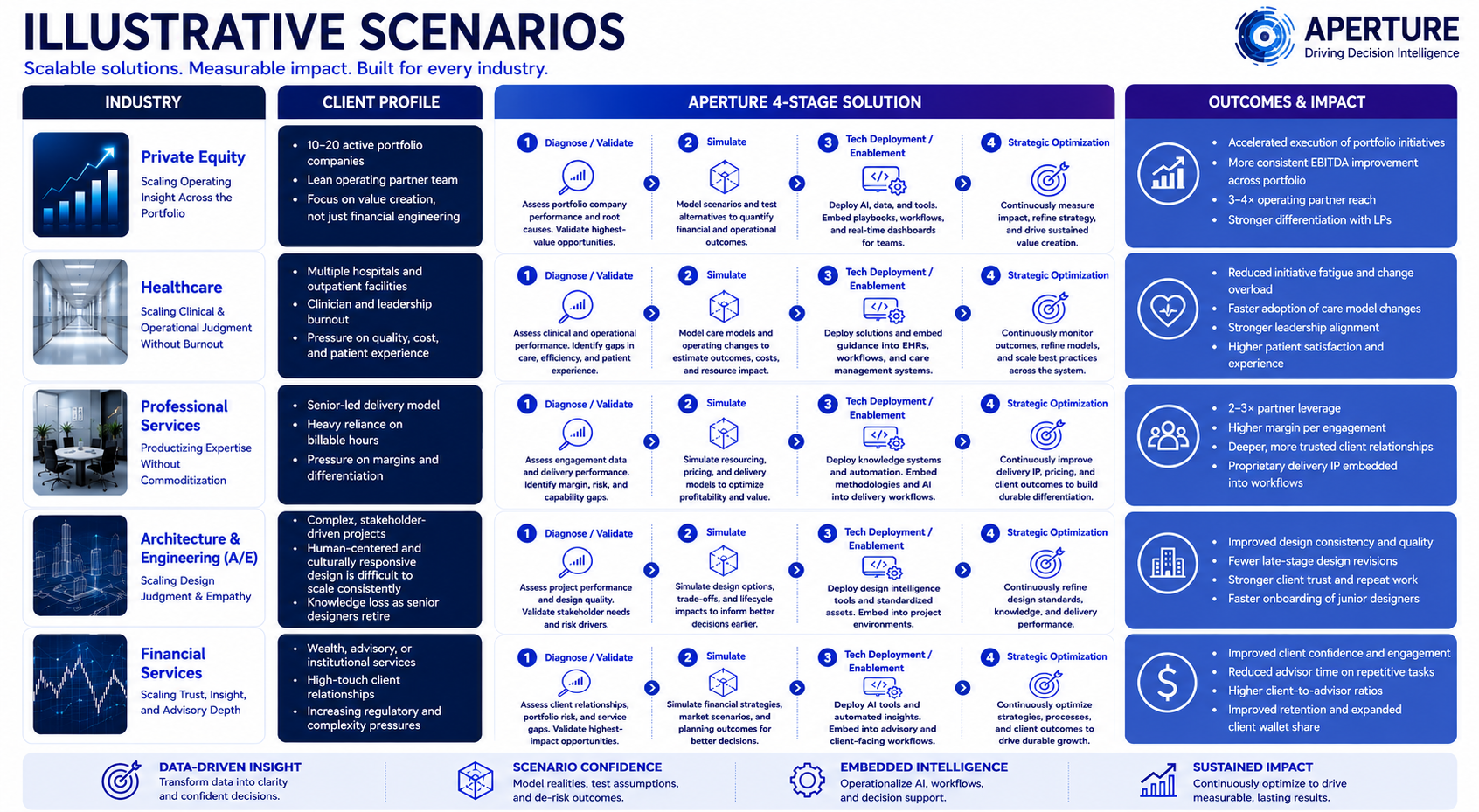
Private equity clients typically operate with 10 to 20 active portfolio companies, a lean operating partner team, and a focus on value creation beyond financial engineering. Aperture works through four stages: first diagnosing portfolio company performance and root causes to validate the highest-value opportunities; then simulating scenarios and testing operating levers to quantify financial and operational outcomes; then deploying AI, data, and tools with embedded playbooks, workflows, and real-time dashboards for teams; and finally continuously measuring impact, refining strategy, and driving sustained value creation. Clients consistently see accelerated execution of portfolio initiatives, more consistent EBITDA improvement across the portfolio, 3 to 4 times operating partner reach, and stronger differentiation with LPs.
Healthcare clients typically operate multiple hospitals and outpatient facilities, face clinician and leadership burnout, and are under pressure on quality, cost, and patient experience. Aperture begins by assessing clinical and operational performance and identifying gaps in care, efficiency, and patient experience. It then models care models and operating changes to estimate outcomes, costs, and resource impact. In the deployment phase, Aperture embeds solutions and guidance into EHRs, workflows, and care management systems. Finally it continuously monitors outcomes, refines models, and scales best practices across the system. Outcomes include reduced initiative fatigue and change overload, faster adoption of care model changes, stronger leadership alignment, and higher patient satisfaction and experience.
Professional services clients typically rely on a senior-led delivery model, have heavy reliance on billable hours, and face pressure on margins and differentiation. Aperture begins by assessing engagement data and delivery performance to identify margin, risk, and capability gaps. It then simulates resourcing, pricing, and delivery models to optimize profitability and value. In the deployment phase, Aperture deploys knowledge systems and automation and embeds methodologies and AI into delivery workflows. It then continuously improves delivery IP, pricing, and client outcomes to build durable differentiation. Outcomes include 2 to 3 times partner leverage, higher margin per engagement, deeper and more trusted client relationships, and proprietary delivery IP embedded into workflows.
Architecture and Engineering clients typically manage complex, stakeholder-driven projects where human-centered and culturally responsive design is difficult to scale consistently, and where knowledge loss as senior designers retire is a persistent risk. Aperture begins by assessing project performance and design quality and validating stakeholder needs and risk drivers. It then simulates design options, trade-offs, and lifecycle impacts to inform better decisions earlier. In the deployment phase, Aperture deploys design intelligence tools and standardized assets and embeds them into project environments. It then continuously refines design standards, knowledge, and delivery performance. Outcomes include improved design consistency and quality, fewer late-stage design revisions, stronger client trust and repeat work, and faster onboarding of junior designers.
Financial services clients typically manage wealth, advisory, or institutional services, maintain high-touch client relationships, and face increasing regulatory and complexity pressures. Aperture begins by assessing client relationships, portfolio risk, and service gaps to validate the highest-impact opportunities. It then simulates financial strategies, market scenarios, and planning outcomes to support better decisions. In the deployment phase, Aperture deploys AI tools and automated insights and embeds them into advisory and client-facing workflows. It then continuously optimizes strategies, processes, and client outcomes to drive durable growth. Outcomes include improved client confidence and engagement, reduced advisor time on repetitive tasks, higher client-to-advisor ratios, and improved retention and expanded client wallet share.
Our team responds within one business day.